Overcoming Lead-oxide Price Volatility
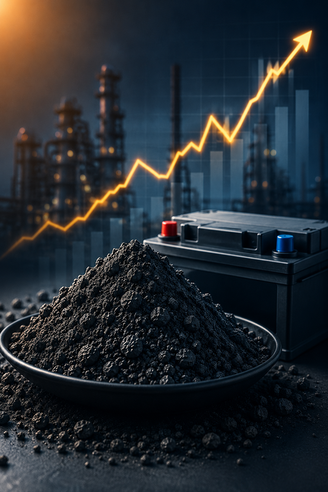
I) Understanding the Lead Market DriversA) Energy Costs: Since the Barton Pot and Ball Mill processes are electricity-intensive, a spike in industrial energy prices will drive up the lead oxide premium even if the LME lead price remains flat. B) Refined Lead Metal Prices: Lead metal accounts for 90–95% of lead oxide cost. Any movement in LME/spot lead prices directly impacts lead oxide prices, usually with a 2–6 week lag.Volatility in mining output, smelting capacity, and inventories strongly affects prices. C) Additives & Carbon Technology: The Cancrie AdvantageIn 2025, manufacturers are increasingly adding carbon and silicon to lead oxide pastes to compete with Lithium-ion. While standard “doped” oxides often carry a high price tag, this is where Cancrie provides a strategic breakthrough for energy storage manufacturers. The future of lead-acid in energy storage isn’t just about better hedging on the LME; it’s about material efficiency. Solutions like Cancrie allow manufacturers to de-risk their supply chain by needing less raw lead while simultaneously delivering a superior battery performance.Direct Financial Hedge: Reducing Lead Oxide IntensityThe most immediate benefit of Cancrie’s technology is the ability to reduce the total amount of Lead Oxide required in each battery.The Result: This acts as a “physical hedge” against LME price hikes. When lead prices soar, a battery that requires 5-8% less lead oxide inherently carries a lower risk profile and a more stable price point for the end consumer.Beyond Cost: A Quantum Leap in PerformanceWhile reducing lead content protects your margins, the application of Cancrie nano-carbons delivers a major jump in the battery’s core performance parameters:I) Higher Charge Acceptance: Cancrie’s nano-carbons facilitate faster electrochemical reaction kinetics, allowing the battery to absorb energy much more efficiently (up to 25% better in solar/inverter applications). II) Extended Life Cycle: By preventing “permanent sulfation”—the leading cause of lead-acid failure—Cancrie can increase the battery’s cycle life by 20% to 50%, significantly lowering the total cost of ownership (TCO). III) Facilitating Fast Charging: The interconnected porous structure of the nano-carbon lowers internal resistance, supporting higher current rates (up to 0.2C) for rapid recharge cycles. IV) Reduced Thermal Runaway: Improved electrical and thermal conductivity helps dissipate heat more evenly across the electrode, preventing the localized “hot spots” that lead to thermal runaway and battery swelling. V) Increased Electrode Strength: The nano-carbons act as a structural “skeleton” within the paste, increasing active material cohesion strength by up to 4X. This prevents plate shedding and degradation, especially in high-vibration or deep-cycle environments. More than 2 results are available in the PRO version (This notice is only visible to admin users) Recent Post Why Charge Acceptance Matters in Batteries – And How Cancrie Nanocarbon Is Improving It Bycancrie May 23, 2026 Uncategorized Charge acceptance refers to a battery’s ability to efficiently absorb and store electrical energy… Read More Boosting Lead-Acid Battery Performance with Cancrie Nanocarbon Bycancrie April 19, 2026 Uncategorized Lead-acid batteries have long been a staple in various applications like inverters, solar energy… Read More Enhancing Automotive Lead-Acid Battery Performance with ‘Cancrie’ Nanocarbon Bycancrie April 19, 2026 Uncategorized ‘Cancrie’ Nanocarbon is a next-generation negative plate additive engineered to tackle these… Read More Next-Gen Solar Battery by Cancrie Nanocarbon Bycancrie April 19, 2026 Uncategorized Why Traditional Solar Batteries Struggle Solar batteries operate in harsh conditions—irregular… Read More Why Cancrie Designs Processes Around Material Behaviour, Not Just Machines Bycancrie April 19, 2026 Uncategorized Why Material Properties Matter More Than Machinery In industrial processing, discussions often begin… Read More